
StackSecure originated as a bootstrapped passion project. We're a group of friends & colleagues coming together from diverse professional backgrounds, passionate about provising affordable SAST to all. Many of us came from software engineering, DevOps, or AI/ML academia. I've been really grateful to sit on the other side of the table with these folks, working to create unique & timely SAST detections for future customers.
As a red team lead by day, practicing and training through bug bounty has always been an effective way to acquire and maintain a realistic skillset. Pivoting to traditional security research (where one may be awarded a CVE, instead of a bounty payout), can oftentimes be closer than expected, unintentional, and uniquely rewarding. Likewise, the experience gained is priceless, understanding how to discover, leverage, and mitigate vulnerabilities beyond misconfiguration.
Earlier this year, I discovered an exploitable vulnerability on a public-facing web app. A common occurance at times in my line of work, but what made this one different was the root cause. After some in-depth validation on my part, it turned out to be a SAST finding discovered from the other side, public-facing & in production.
Coming from bug bounty, the reporting process for this was distinctly unique. My goal with this series is to not only to raise awareness of where SAST vulnerabilities can surface in production, but to provide resources, either my own or with proper citations for the everyday security researcher.
This will be the first of more to come where I'll talk about my journey, bridging offensive security and SAST - this is Offensive Security Uncovered :)
The Workflow
So here you are, fellow researcher... you're participating in a bug bounty program and your findings were identified to be out-of-scope. But fear not! As you read the response from triage, you're forwarded to the software vendor for further analysis. You've found your first potential CVE and its time to report, congrats!
Should be a straightforward and easy process, right?
Before submitting a request to MITRE, you must determine if the target application is managed by a CVE Numbering Authority (CNA).
- A CNA is a vendor (such as Adobe or specific software companies) authorized by MITRE to assign their own CVE IDs.
- If the product belongs to a CNA, you must request the CVE ID directly from that vendor rather than MITRE.
- If you are interested in how a vendor becomes a CNA, I stumbled upon a document from NIST explaining the entire process, NISTIR 8246.
Identifying the CNA
There are a few ways you can identify a CNA. If you are an ethical hacker or red teamer, think of this as an extention to the reconnaisance or discovery operations phase.
Use the List of Partners Search Engine hosted on cve.org.
- You'll want to search for CNA & CNA-LR (CVE Numbering Authority of Last Resort)
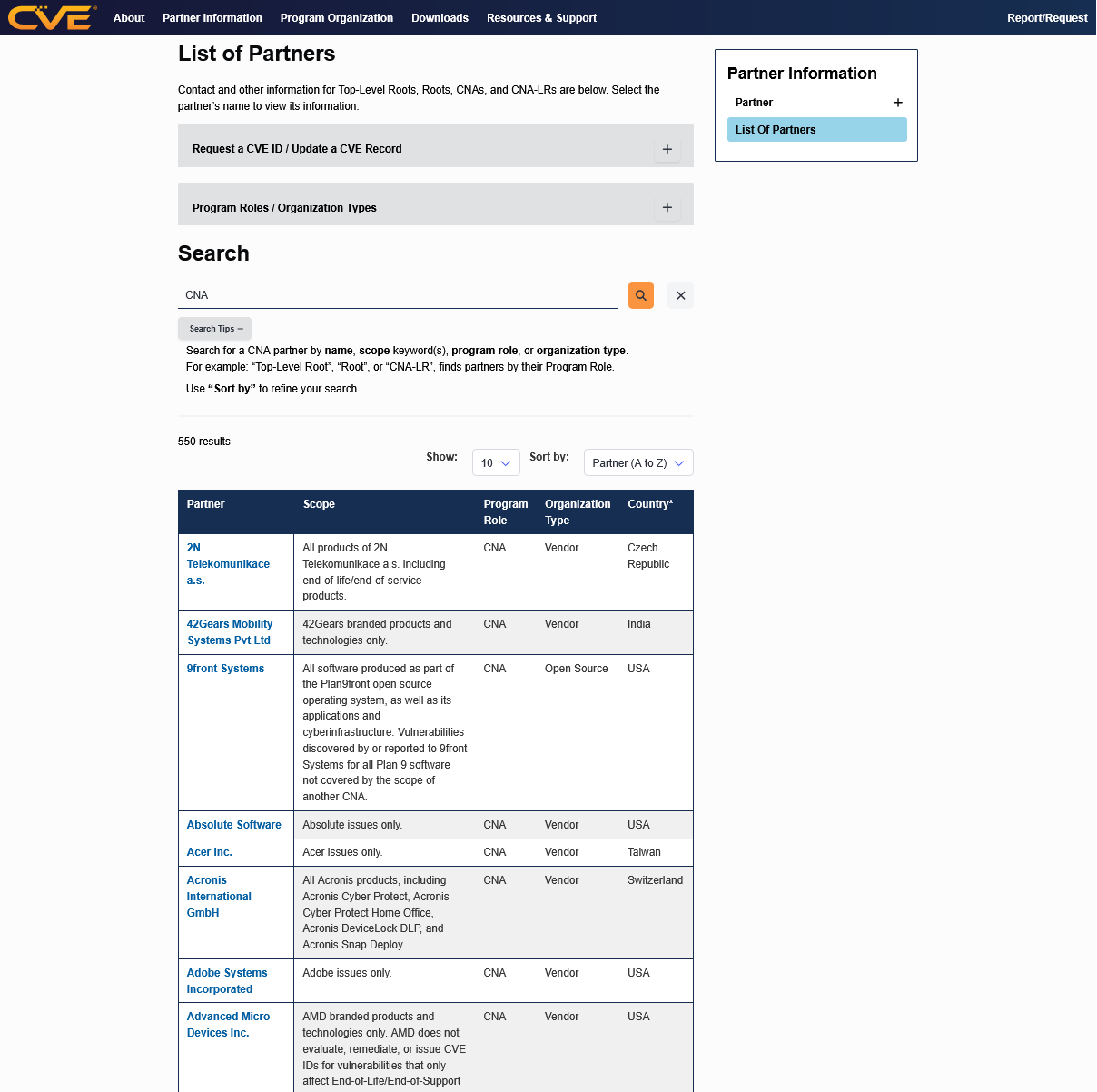
- You'll want to search for CNA & CNA-LR (CVE Numbering Authority of Last Resort)
Dork for security.txt
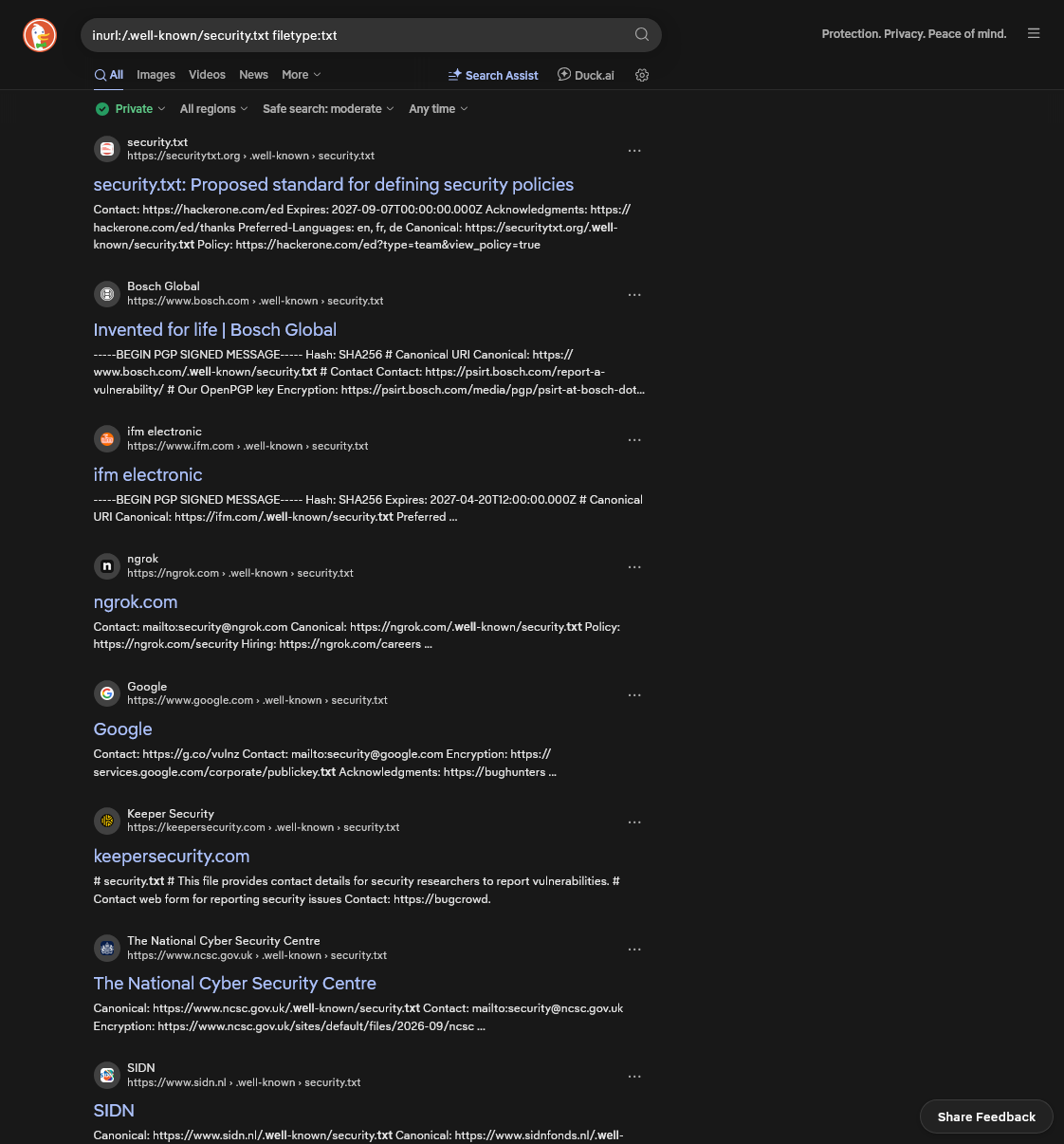
inurl:/.well-known/security.txt (company-name-here)
inurl:/.well-known/security.txt filetype:txt (company-name-here)
inurl:/.well-known/security.txt filetype:txt site:domain.tld- Security.txt files assist ethical hackers and security researchers with responsibly disclosing their findings.
- IANA standardized the format in RFC 9116 to assist site owners in collaborating with security researchers.
- The format gained populatity prior to standardization with RFC 9116 in a 2021 evaluation by Tara Poteat & Frank Li at Georgia Institute of Technology. The evaluation highlighted its potential, but lack of implementation across domains at the time. Hence, the need for alternative search methods arose.
- Security.txt files assist ethical hackers and security researchers with responsibly disclosing their findings.
Use alternative search engines
A handful of specialized search engines have arose for responsible disclosure contacts.
Disclose.io - Open-Source, offers a search engine for their security contact database
- Front-end for their open-source dataset, diodb
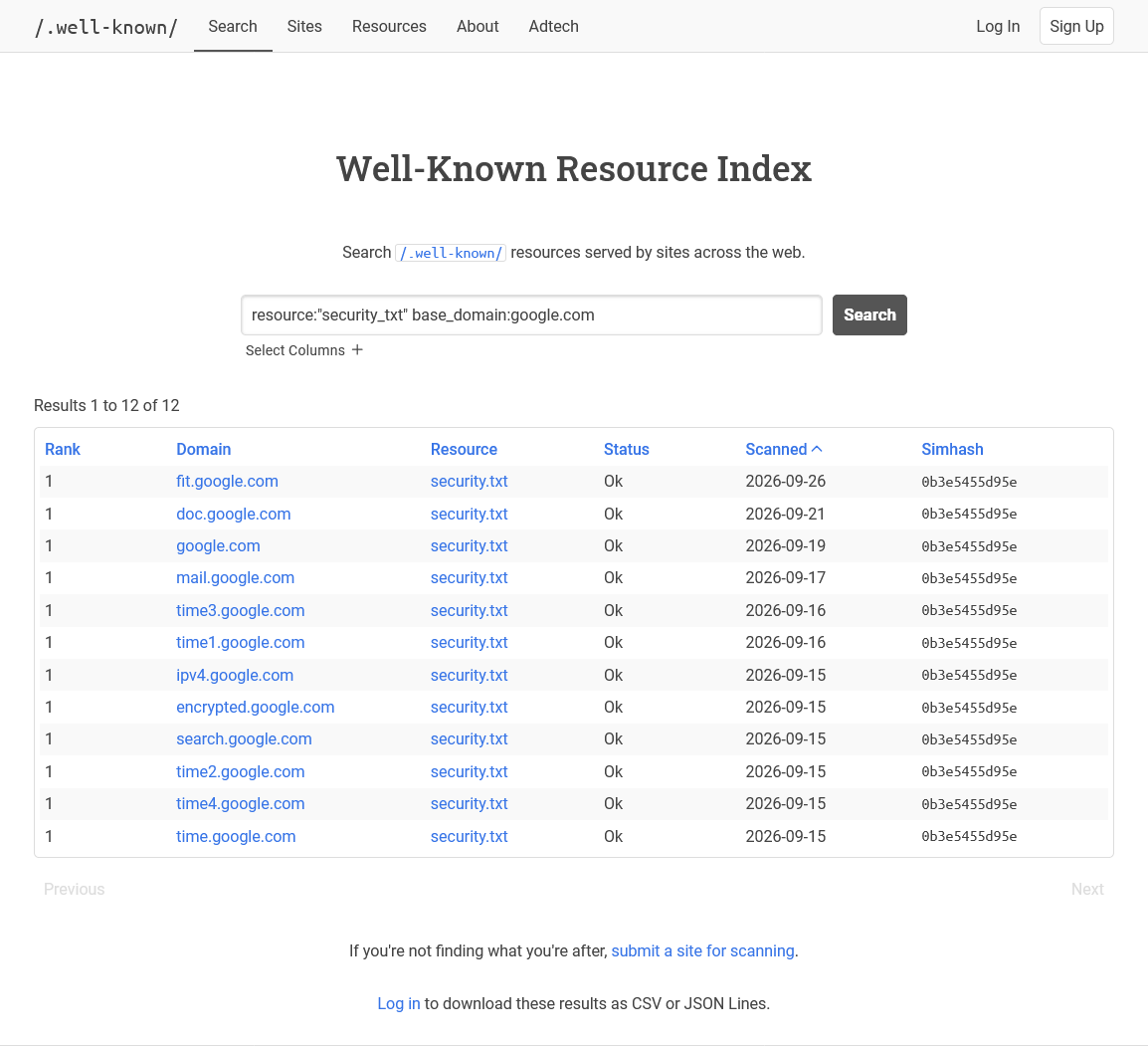
resource:"security_txt" base_domain:google.com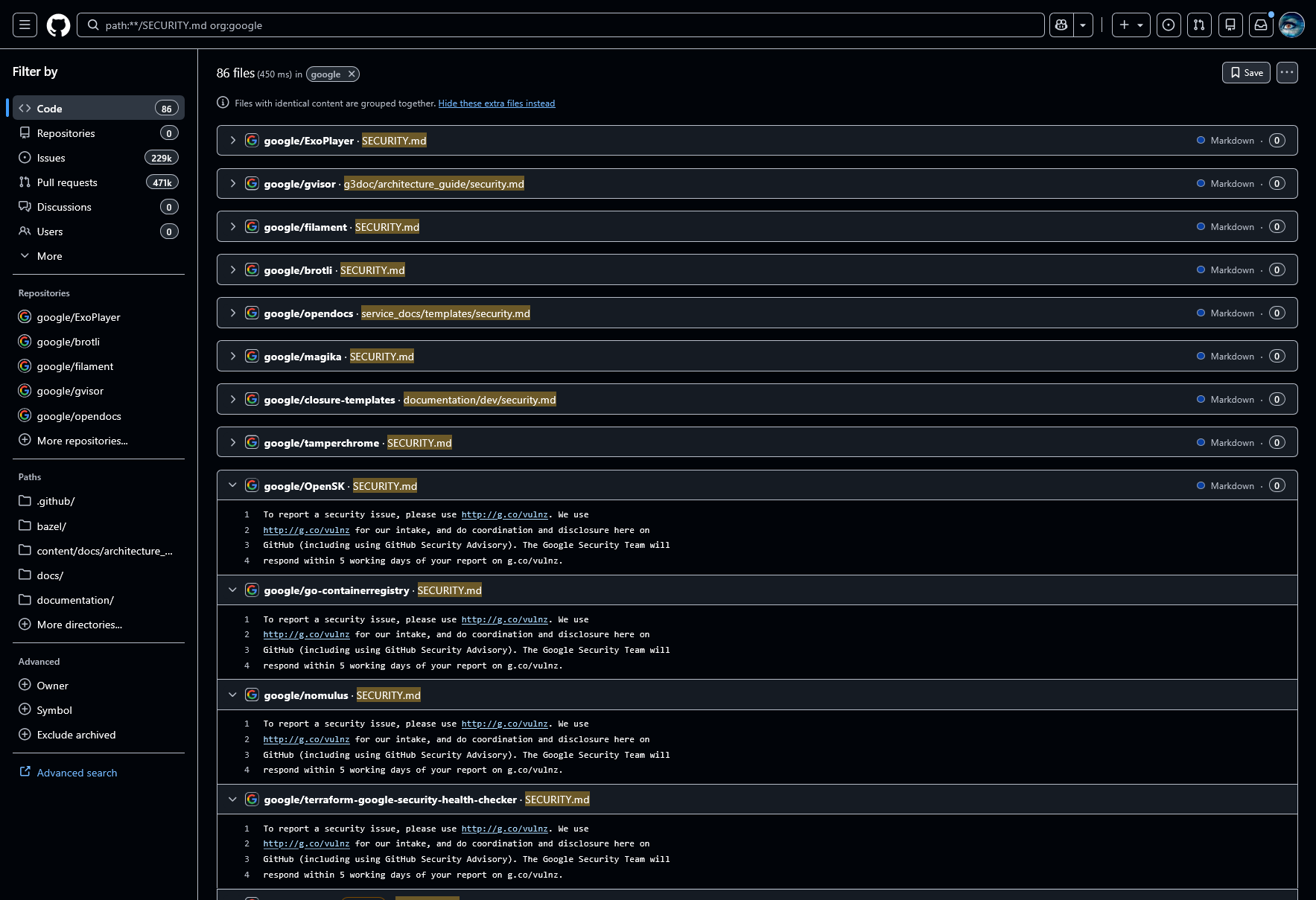
path:**/SECURITY.md org:googleA SECURITY.md file is a standard document placed in the root or .github directory of a code repository to inform users and security researchers how to handle and report security issues.
Writing The Report
The report writing process can vary greatly based on the problem type and impact of the vulnerability. Depending on the CNA, the quality of their reporting portal can vary as well. If you are a developer, think of this as the user experience (UX) for ethical hackers. As an ethical hacker, it isn't uncommon to feel lost or unsupported in this process. The first time I did this, it actually slowed down my report and required extra research on my end.
Reporting Template
I ended up using a template created by Evan Issac of MRE Security. He also has a really awesome video around this process. Check it out!
# [Vulnerability Name]

#### Severity Score: [Severity]
#### CVSS Score: [CVSS Score]

## Description

[Description About the Vulnerability]

## Impact

[Impact Statement]

### POC

[Reproduction Steps]

## Remediation

[Remediation Steps]